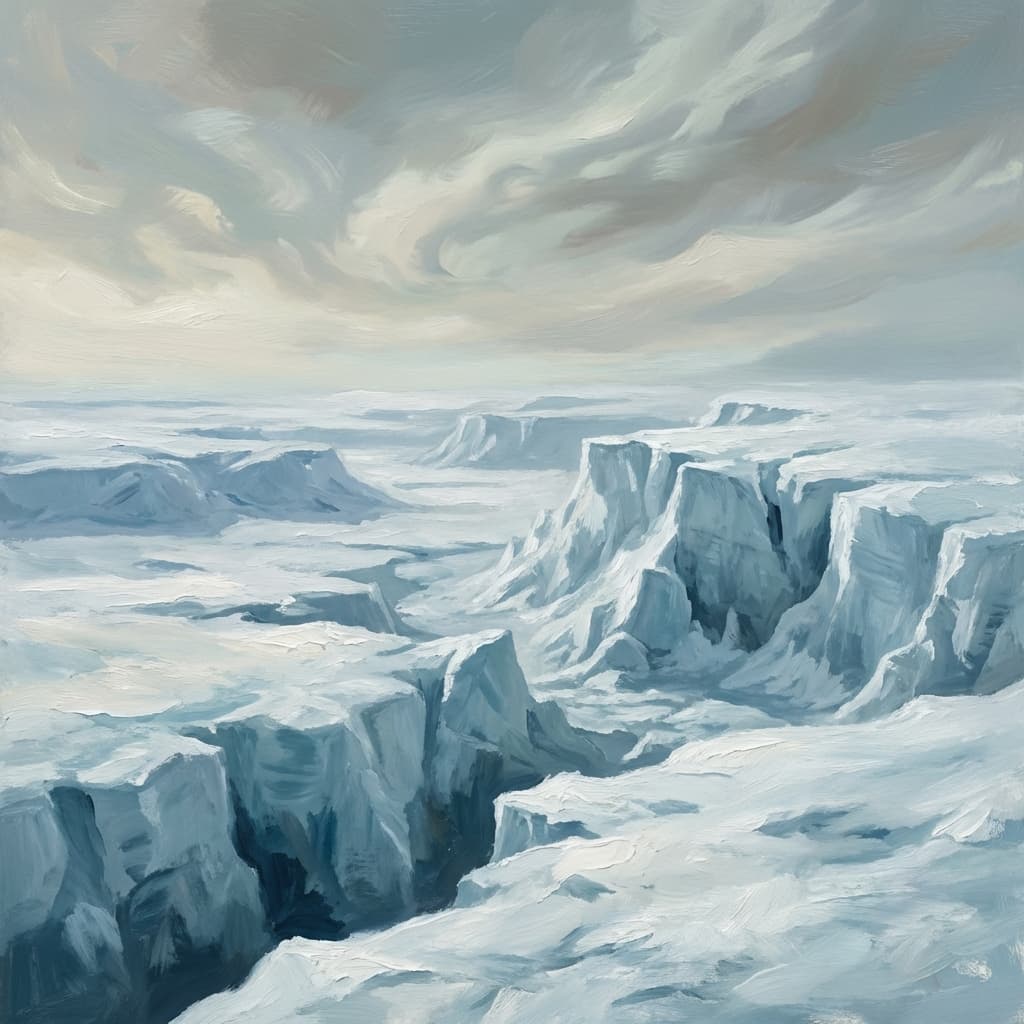
Exploration and surveying
The world does not come labeled. Teams on the ground turn terrain into knowledge, one region at a time.
Ground truth
A freshly landed colony knows almost nothing about the world beyond what orbit could see — and orbit sees a picture, not a measurement. The geography a panel states about a region — how livable it is, how warm, how wet, how hazardous, what could grow or stand there — derives from exactly the locations somebody has walked, sharpens as the survey grows, and reads honestly unknown where nobody has set foot. Sending a team to survey a region reveals what actually lies there — terrain, hazards, water, and the deposits worth coming back for. Every Scout you train widens the circle of ground you can trust.
Walking across a region is not the same as surveying it. A column on the march opens the ground under its own route, and a unit parked somewhere reads its immediate surroundings — but neither pushes the frontier, and neither finds what the ground hides. Springs, hot ground and ore stay buried until a team is actually working there, so a unit left standing around is not quietly mapping the region for you. Terrain types, on the other hand, are learned like a language: once a crew has walked a kind of ground anywhere, its name reads off the map everywhere it appears — the measured values still wait for boots on that particular ground.
An entrusted survey works around a centre you choose — the team's own region, or a place you point at on the map: a whole sector when zoomed out, a single region when zoomed in. The expedition works outward in rings of that unit and finishes a ring before opening the next. Closing every region of a sector is a discovery in itself: a large research payout, a chronicle entry and a milestone.
Exploration is paid for in time and exposure. A team in the field is a team not building, and hostile ground takes its toll on the people crossing it.
The ground itself sets part of the pace. An open plain surveys fastest; forest slows the work, and swamps, marshes and broken rock slow it most — canopy hides the ground and hard walking costs hours. A vehicle riding with the team beats part of that penalty down, though it never makes the looking itself faster. And when you entrust surveying to a commander as a standing order, you can fence the work to chosen kinds of ground — open country, vegetation, wetlands, rough ground or open water — so the expedition maps what you actually care about and skips the rest.
Word travels the link
You know what command knows. While the colony ship holds orbit it acts as a satellite, keeping every team connected wherever it walks — but the ship does not last, and once it breaks up, a team beyond the reach of your comm network goes dark. It keeps exploring; you simply stop hearing about it. The map it uncovers, the deposits and springs it finds, even the naming of the land — all of it arrives at once, the moment the team walks back into contact. A crew lost in the dark takes its report with it, and only the next expedition over the same ground can bring those finds home.
The silence cuts both ways. A commander out of contact runs on their own judgment, and the crew plans its resupply on the stocks it remembers, not the ones that are — empty shelves are discovered on arrival. Building relays before the ship gives out is what keeps the frontier speaking.
Reading deeper
The surface is only the first layer. Research like Prospecting teaches the colony to read the signs of what runs underneath — where to hunt, never exactly what hides there. Reaching the deeper strata takes instruments the expedition may not have brought, and the rarest deposits sit at the bottom. Seeing a deep deposit is not the same as working it: the facilities that mine the deeper strata are their own line of development the colony must earn. The same holds under the sea — a survey can chart a deposit on the sea floor, but working it needs offshore technology the colony does not yet have.